

How to Choose an Interior Designer in Malaysia: A Practical Checklist
A good-looking portfolio is easy to find. It's also one of the least useful things to base your decision on. What matters just as much is how the designer actually works — the drawings they produce, how fees are structured, who supervises the site, and what happens when something changes.
Send us a few photos of your space, your property type and a rough budget band. We'll walk you through what to check before you commit to anyone.
Taste is easy to judge. Process is what determines the outcome.
Most homeowners start by scrolling portfolios, and that's a reasonable place to start — it tells you whether you like someone's style. It just doesn't tell you much else. Two designers can produce equally beautiful renders but run their projects very differently. One may work from detailed drawings, price changes before they happen and tie payments to completed work. Another may rely on a vague scope, a lump-sum quote and decisions made as the site progresses.
This guide focuses on the things you can check before signing anything: the drawings, fees, references and working process. It's written for the Malaysian market specifically, where design and construction are often bundled and titles like "interior designer" and "interior design company" get used loosely.
If you're still deciding whether you need a designer at all, rather than which one, our interior designer vs contractor guide covers that first decision. This one assumes you've settled that and are now comparing actual candidates.
Five things to check before you shortlist anyone
These are roughly in order of importance. The first two catch most of the problems that surface later in a project.
Ask to see a real drawing set
Not a render — a layout plan, a carpentry elevation, a ceiling and lighting plan. If all you can see are finished photos, it's hard to tell how the designer turns an idea into something a contractor can actually build.
Understand the fee structure early
Whether it's a fixed design fee, a percentage, a rate per square foot or part of a design and build package, find out what's included and what could cost extra.
Check references close to your property type
A designer's best-ever project tells you less than a recent project similar in size and property type to yours. Ask specifically for that comparison.
Ask how variation orders are priced
Changes happen on almost every project. What matters is whether each one gets priced and signed off before it's built, or simply shows up in the final bill.
Confirm who is on site day to day
The person you meet for the pitch isn't always the person supervising the build. Ask who you'll actually be dealing with once work starts.

How to Compare Interior Designer Quotations in Malaysia
Two quotations with similar totals can cover very different scopes. That's why comparing only the final figure can be misleading.
| Line item | What to check | Why it matters |
|---|---|---|
| Carpentry | Priced by piece with sizes and named material grade, not a flat allowance. | Usually the largest single cost — vague carpentry is where budgets quietly inflate. |
| Electrical points | Counted individually against the furniture layout. | Adding a point after walls are finished means chasing already-closed surfaces. |
| Ceiling and lighting | Scope described — cove, downlights, switches — not just "ceiling works." | Positions are very difficult to change once the plaster ceiling is closed. |
| Material schedule | Named products and codes, not categories like "laminate." | The price can vary widely within a category; a specific product is much easier to compare. |
| Exclusions | Written down explicitly, not implied. | What's excluded from one quote often explains why it looks cheaper than another. |
Carpentry
Priced by piece with sizes and named material grade, not a flat allowance.
- Why it matters
- Usually the largest single cost — vague carpentry is where budgets quietly inflate.
Electrical points
Counted individually against the furniture layout.
- Why it matters
- Adding a point after walls are finished means chasing already-closed surfaces.
Ceiling and lighting
Scope described — cove, downlights, switches — not just "ceiling works."
- Why it matters
- Positions are very difficult to change once the plaster ceiling is closed.
Material schedule
Named products and codes, not categories like "laminate."
- Why it matters
- The price can vary widely within a category; a specific product is much easier to compare.
Exclusions
Written down explicitly, not implied.
- Why it matters
- What's excluded from one quote often explains why it looks cheaper than another.
If these five points aren't clear from the quotation, ask for a breakdown before comparing it with another one.

A designer who asks about your life before your style
Before a single finish is chosen, a good designer asks how you actually live — what's in your wardrobe, how often guests stay over, whether you cook daily or rarely. Those answers decide hanging heights, drawer counts and storage before style does.
If the first conversation jumps straight into colour palettes and mood boards, without asking how you use the space, the result is more likely to look right than work right.
What to weigh differently by property type
The checklist above stays the same, but which answers matter most shifts with the property.
Condominiums and serviced apartments
Ask specifically about management approval experience, lift booking and working within fixed wet-area positions. Each building has its own process, and an unfamiliar designer may underestimate the time needed for approvals.
Terrace and link houses
Ask about structural change experience, staircase zoning and whether council submissions are handled in-house or outsourced. That can affect your timeline.
Semi-D and bungalow
Ask to see a project of comparable scale. A large home brings a different challenge: keeping the design consistent across many rooms without making everything feel repetitive.
Red flags worth walking away from
A large upfront payment not tied to a clear milestone
Payment stages should be tied to completed work. A big deposit with little tied to it is a warning sign, especially if later stages also aren't clearly milestoned.
A single lump-sum quote with no breakdown
Without an item-by-item breakdown, there's no way to compare the quote against another one or to price a future change against it.
Reluctance to put variation pricing in writing
If changes are agreed verbally on site, they can easily turn into disputed charges later. Get the price and approval in writing before the work goes ahead.
No drawing set, only renders
A render can show a walkway that doesn't exist at that width. Ask for the dimensioned plan alongside it — they should agree, and sometimes they don't.
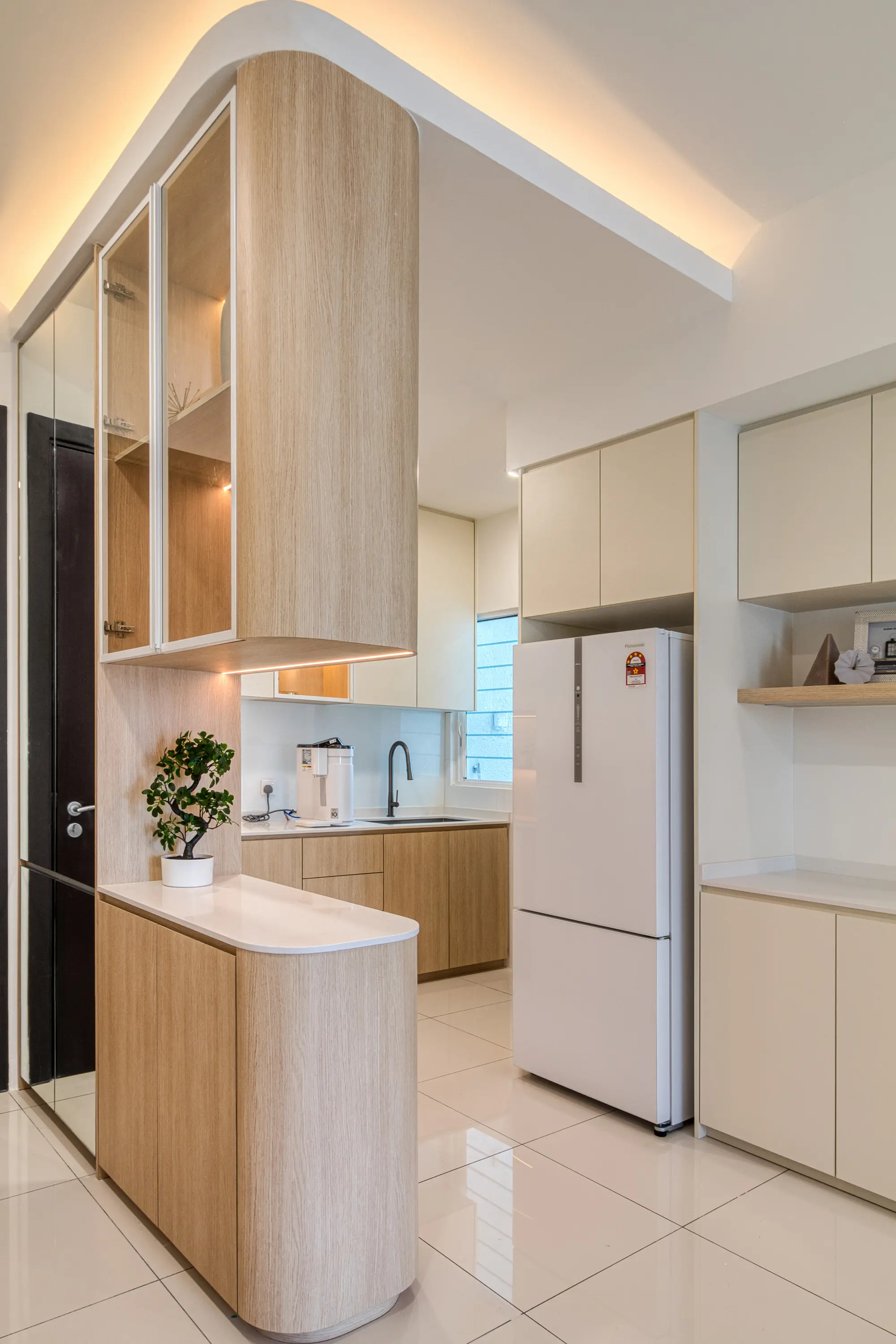
Three common situations homeowners choose from
Comparing three portfolios that all look good
When style alone can't separate the candidates, ask each designer for a sample drawing set and an explanation of their fees. That comparison often tells you more than the renders do.
A friend's recommendation with no written process
A personal referral is a good starting point, not a substitute for the checklist. Ask the same questions about drawings, fees and variation pricing even when the introduction came through someone you trust.
Two quotes, two very different totals
Before assuming the cheaper one is the better deal, line up what each includes. A cheaper quote may look good at first, but it might leave out the ceiling, use a lower material grade, or count fewer electrical points.
What a first conversation with us looks like
Share the basics
Property type, rough size, photos of each room, your budget band and when you'd like to move in.
See how we work before deciding
We can walk you through a sample drawing set, explain how our fees work and show you how changes are handled before you decide whether to proceed.
Site visit and measurement
Measuring up, checking existing services, and anything that constrains the layout.
Itemised quotation
Priced line by line against the drawings, with exclusions written down, so it can be compared against another quote if you want to.
What to prepare before your first designer meeting
Photos of every room
Wide shots from the doorway, plus anything that already bothers you.
The floor plan
Developer plans or the sale-and-purchase layout, if you still have them.
Five or six references
What they have in common tells us more than any style label would.
A budget band
A range is enough to check whether a scope is realistic before anyone starts drawing it.
What we are happy to show you before you decide
You should be able to ask us the same questions we've suggested asking any other designer. We can show you sample drawings, explain how our quotations are structured and walk you through how variations are handled before you decide whether we're the right fit.
Real drawings on request
A sample layout, carpentry elevation and material schedule, available for review before you decide.
Itemised, not lump sum
Quotations broken down by item so you can compare them and price changes later.
One point of contact
The same person through design and build, so nothing gets lost between two parties.
No obligation
A first conversation about feasibility and budget doesn't commit you to anything.
Questions to Ask an Interior Designer Before Hiring Them
What is the single most important thing to check before hiring an interior designer?
Whether their drawing set is complete enough for a contractor to price and build from without guessing. A portfolio tells you whether you like the designer's style. A sample drawing set tells you whether there is a solid process behind it. Ask to see a layout plan, carpentry elevations, ceiling and electrical plans, and a material schedule.
How do I compare quotes from different interior designers in Malaysia?
Line up what each quote actually includes rather than the total. Carpentry should be itemised by piece with sizes and material grade, electrical points counted, ceiling and lighting scope described, and exclusions written down. A lower total that excludes the ceiling or a named material grade isn't actually cheaper — it's an incomplete quote.
Should I choose an interior designer in Kuala Lumpur based on their portfolio alone?
No. A portfolio shows you whether you like their style; it tells you almost nothing about how they handle variation orders, site supervision or payment stages. Ask about process alongside the portfolio — the designer whose drawings are clear and whose scope is well-defined is usually the safer choice, even with a plainer portfolio.
What questions should I ask an interior designer before signing a contract?
Who runs the site day to day, what the drawing set includes, how payment stages line up with completed work, how variation orders are priced and approved, and what happens to the drawings if you don't proceed to build. You want clear answers to these questions, preferably in writing. If the details are vague before signing, they rarely become clearer once work starts.
How much experience should an interior designer in Malaysia have?
Years in business matters less than relevant experience with your property type and scope. A designer with five years of condo-only projects may be a poor fit for a landed-house extension, and vice versa. Ask for examples close to your own property type and size, not just their best work overall.
Is it normal for an interior design company to also handle the construction?
Yes — design and build is a common arrangement for residential renovation projects in Malaysia, since it puts one party in charge of both and gives you one point of contact. It isn't the only valid arrangement, but if you're offered it, check that the design output is still complete (real drawings, not a verbal plan) even though the same company is building it.
What red flags should I watch for when choosing an interior designer?
A large upfront payment not tied to a clear milestone, a quotation with no item breakdown, reluctance to put variation-order pricing in writing, and an inability to show a real drawing set rather than renders alone. Any one of these is worth a direct question before signing; more than one is worth walking away from.
Do I need to see an interior designer's registration or qualifications?
It's reasonable to ask. For residential work, you'll come across firms with different professional backgrounds and qualifications, and registration alone doesn't indicate quality. What matters more in practice is whether they can show a complete drawing set and clear references from projects similar to yours.
How do I choose an interior designer for a condo versus a landed house?
For a condo, prioritise experience with management approvals, lift booking and working within fixed wet-area positions. For a landed house, prioritise experience with structural changes, extensions and council submissions where relevant. Ask specifically about your property type rather than their general portfolio.
What should I prepare before meeting an interior designer for the first time?
Photos of every room, the property type and rough size, the floor plan if you have it, five or six reference images, your budget band and your rough timeline. That's usually enough for a useful first conversation, even before any measurement is taken.
Can I change interior designers partway through a project?
It's possible but disruptive, since drawings, material orders and site sequencing are usually tied to the outgoing designer's decisions. It's far cheaper to get the evaluation right before signing than to switch midway — which is the main reason a proper checklist upfront is worth the time.
Do you help homeowners across the Klang Valley choose between design options?
Yes. We take on interior design enquiries across Kuala Lumpur and Selangor, and the first conversation is about whether your scope and budget are realistic together — not a sales pitch. Send us your property type, a few photos and your rough budget and we'll tell you where things stand.
Still comparing designers?
Send a few photos, your property type and your rough budget. We'll help you understand what likely needs checking first — whether that's the drawings, the fee structure, or the scope itself.
Request a consultation